Craft, patience, and contempt for money
The Power of the Dog (Thomas Savage Edition)Craft, patience, and contempt for money are closely joined in Phil Burbank’s habits of observation and work. He prizes the time and skill embodied in handmade objects, and distrusts people who turn other people’s carelessness or labor into quick profit. Yet his own dealings show that this contempt is not a simple rejection of wealth: he knows the value of what he possesses, can use that knowledge strategically, and sometimes takes satisfaction in letting an eager pursuer waste time. The ethic is both a genuine respect for skilled work and a source of irony about Phil’s judgment of others.
Objects as a Record of Attention
Phil’s glass-fronted bookcase contains no books or magazines. Instead, it holds a carefully arranged collection that makes patient attention visible. Arrowheads are mounted against green felt in a balanced fan pattern; one of the finest has been fitted into an arrow shaft. Fossils of trilobites and ferns preserve traces of a landscape once covered by ancient waters. A wolf skull and a stone marten that Phil trapped, killed, skinned, stuffed, and mounted display other kinds of close observation and practical ability. The collection is not simply a store of curiosities: the arrangement and preparation of its contents reveal a talent for noticing distinctions, handling materials, and sustaining effort until a piece is finished.
The shelf of rocks includes water-crystal, agate, and a fist-sized piece of gold-bearing quartz. A mining engineer visiting from Salt Lake City recognizes its possible value and asks where Phil found it, whether it was assayed, and whether he searched for the vein. Phil has done neither of the first two things, but his calm response does not mean he is ignorant of the quartz’s worth. He knows what it is. He once tried to relocate its source and failed, then gives the visitor a misleadingly imprecise location near Black Tail Creek. The episode distinguishes knowledge from the urge to convert knowledge into a sale: Phil keeps the specimen and declines the engineer’s prospecting logic, but he also uses what he knows to manipulate the visitor’s expectations.
Patience, Knowledge, and the Price of Gold
Phil’s patience becomes active when the engineer’s party returns the following summer. From his window, he watches the visitor and his companions search with picks and shovels in the wrong place, blistering their hands in pursuit of a vein that lies about twenty miles away. Phil has known their search would come, and waits until the party is about to give up before riding there. He then hears the engineer offer an explanation for his expedition, framed as a wish to find quartz for a museum. Phil’s amusement rests on a reversal: the man who had treated the stone as an opportunity has been made to labor for a false lead, while Phil has spent his time watching rather than digging.
The scene gives Phil’s contempt for money a concrete object and consequence. He dislikes people who humiliate themselves in pursuit of profit, and the failed search lets him expose what he sees as their eagerness. But his conduct is not neutral generosity. He withholds the true location and engineers the visitors’ wasted effort; his independence shades into a desire to outwit and embarrass those who seem greedy. The quartz thus holds together two sides of the ethic: Phil recognizes natural and material value without needing to sell it, while his calculated deception shows that contempt for the marketplace can itself become a form of power.
Joe, Braiding, and Inherited Skill
Phil’s understanding of craft also includes compassion for people whose lives have been marked by loss or hardship. He admires a former circus worker who left that work after his young daughter, once billed as an aerial artist, fell during a performance. Phil reads the father’s grief and respects his stubborn devotion to the Bible he continues to read. He likewise does not condemn an ex-con named Joe for his past. Rather than interrogate him about his history or the scar on his face, Phil notices what Joe has carried out of prison: the strength to face an uncertain future with dignity and a remarkable skill in working horsehair.
Joe braids black and white hair into watch chains so fine that Phil calculates each contains about a hundred yards of material. The chains are painstaking work made possible by time and concentration. Joe reportedly refuses fifty dollars for a thirty-foot coil of braided rawhide, and Phil admires that refusal: the work made by gifted hands need not be surrendered simply because someone offers money for it. In Phil’s view, Joe has learned in prison to respect time and scorn money, as Bronco Henry learned to place himself beyond ordinary fear of death. The comparison makes craftsmanship a form of inheritance as well as an individual accomplishment.
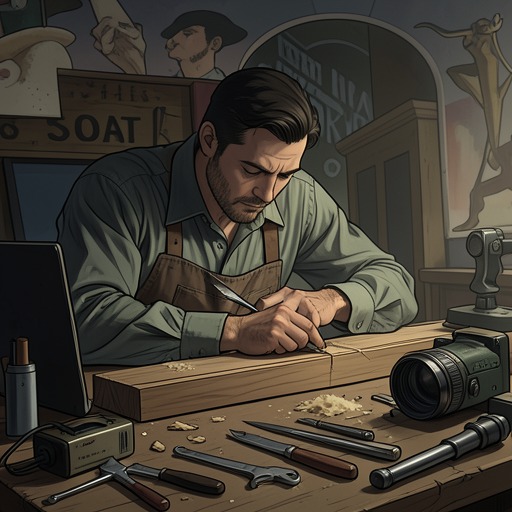
When Phil braids rawhide himself, he does so partly in homage to Joe and Bronco Henry, both of whom taught him something. At first he intends to make only a short length, as proof that he can still braid well. Properly dried away from the sun and finished with tallow, the rope is strong and precise enough for use in the corral. Phil’s work therefore joins memory to utility: a skill received from others becomes a practical object made by his own hands. The narrative links character to braided material, strands joined into a whole that may be beautiful or poorly made. Patience is not merely waiting; it is the time and attention through which a skill, and something learned from one person, can be passed to another.
The Hides and the Limits of Phil’s Ethic
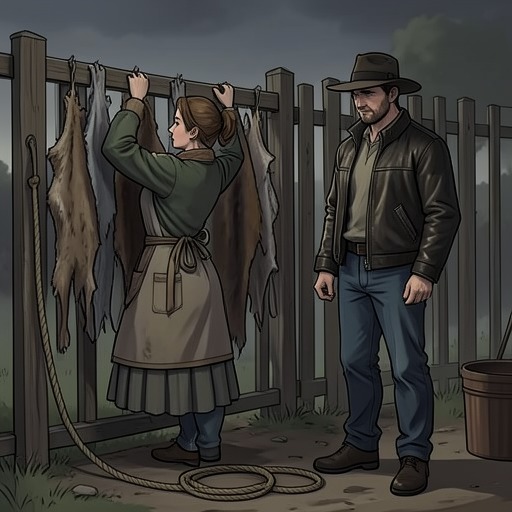
Phil’s treatment of ranch hides puts his principles under pressure. The men butcher cattle and leave the hides hanging over a fence, where magpies pick at scraps of flesh. Because the ranch hands skin clumsily and puncture many of the hides, Phil sees little use for them. He expects that after about a year they will be piled up, doused with kerosene, and burned. Buyers arrive before then, offering a dollar or a dollar and a quarter, but Phil refuses to sell. He believes they resell hides for twice what they paid, and would rather let the hides dry and shrink than help people he considers quick-buck traders.
His refusal is connected to his respect for labor, but the passage also makes clear that prejudice shapes his view of the buyers. Phil generalizes about Jewish traders and directs particular scorn toward the Jewish junk dealers who bargain for hides, scrap iron, and discarded machinery. He contrasts them with Jews of intellect and talent, whom he claims to respect at a distance. That distinction does not undo the prejudice; it exposes its limits. Phil’s ability to value individual skill and to refrain from judging people burdened by hardship coexists with an ethnic stereotype that reduces a group of traders to greed. The novel presents his contempt for opportunism as an ethic with a blind spot, not as an impartial moral standard.
The ranch’s accumulated hides and scrap also make his refusal costly in practical terms: material that other people might sell is left to deteriorate because Phil will not accept their offer or let them profit. When it turns out that he has a use for the hides after all, the earlier assumption that they are worthless is overturned. That reversal sharpens the distinction running through these episodes. Phil is not indifferent to materials or their uses; he observes, stores, and works with them on his own terms. His deepest allegiance is to skilled attention and control over one’s labor, but his pride can turn that allegiance into secrecy, mockery, and needless waste. Craft, patience, and contempt for money are therefore both sources of his independence and measures of the contradictions in his character.